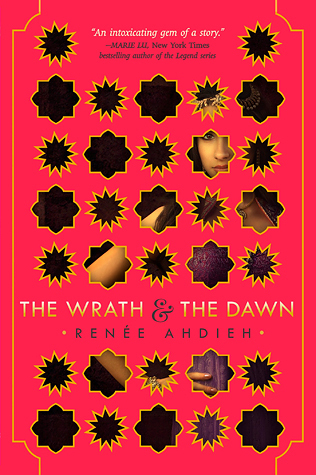
The murder of Shahrzad’s best friend, Shiva, by the Caliph of Khorasan is just the latest death in a devastating pattern of executed brides, so she concocts a lethal plan: volunteer to be his next wife and kill him. Set in a richly written, Arab-inspired fantasy world, Renée Ahdieh’s The Wrath & The Dawn follows Shahrzad as she discovers hidden complexities to the handsome, mysterious Caliph, forcing her to reconsider her desire for vengeance, all while magic and whispers of an uprising slowly simmer in the background. Although overly dramatic at times, the book has incredibly immersive writing and a fun, slow-burn romance. It wasn’t a perfect novel, but overall, it is a very well-written romantasy with a beautiful, unique setting.
“Love is a force unto itself…For love, people consider the unthinkable…and often achieve the impossible.”
The Wrath & The Dawn has wonderfully lyrical writing. The book is in 3rd-person point-of-view with chapters alternating between characters, allowing the reader to experience several interesting settings. The prose is flowery but succinct in its descriptions, although Ahdieh does overly document character facial expressions and movements. Still, she’s excellent at injecting emotion into the story in just a few words, sentences, or paragraphs. The dramatic writing in the romantic scenes is sometimes worthy of an eye roll, but it successfully roots the reader in the plot. Overall, I was able to perfectly picture every setting and character in satisfying detail.
“…no individual can reach the height of their potential without the love of others…the more a person pushes away, the clearer it becomes he is in need of love the most.”
The Wrath & The Dawn has a very quick plot enriched by lush settings. A love triangle is introduced and remains a focal point, as befits a young adult novel. It also contains a hint of magic and story-within-a-story elements. Unfortunately, the plot is one of the weaker elements of the book. I had issues with a smoke-and-mirrors political plan that failed to be dramatic and intriguing – it was built on courage and purpose but lacked strategy. The plan was created very fast, was far too easy to implement, and was neglected in favor of the romantic plot. The most story development is made in the romance, while two other plot lines remain hazy and half formed – despite heavily impacting the outcome of the book. With its overprotective male characters and enemies-to-lovers thread, the plot is a bit predictable – but it’s also a lot of fun, very romantic, and filled with the perfect amount of angst.
“My soul sees its equal in you.”
Two of the main characters felt especially three-dimensional – particularly Shahrzad, a strong-willed, determined, and courageous young woman who’s also a bit too sensitive to perceived slights. She stands up for herself and fights with words before weapons, even though she’s also skilled with a bow and arrow. I really enjoyed the relationship between Shahrzad and the Caliph, Khalid, even if the emotions were sometimes too dramatic to be realistic – ultimately, it strengthened the tension. I also liked the female friendship and sarcastic banter between Shahrzad and her handmaiden, Despina. Another central character, Tariq, falls prey to what I think of as “hero syndrome.” Essentially, I found him too honorable with too few flaws, so I hope I’m given a deeper look into his background and personality in the second novel.
“Some things exist in our lives for but a brief moment. And we must let them go on to light another sky.”
The importance of love – romantic, platonic, and familial – is a heavily present theme throughout The Wrath & The Dawn. It’s the main motivation of every character’s actions. Another theme is the human tendency to judge people based on appearance. The shining example is Khalid. His people believe he’s cruel and uncaring, but Shahrzad slowly unravels the truth behind his stony exterior and wives’ deaths. She herself is another example, as she lives in a patriarchal society that defaults to underestimating and dismissing her. The final important theme is the futility of revenge. Shahrzad and Tariq act out of desires for vengeance, but by the end of the novel, they both witness the painful and fatal harm resulting from their choices. The Wrath & The Dawn highlights how love in all its forms drives every character, while exploring the dangers of judging by appearances and the futility of revenge.
“You have a beautiful laugh. Like the promise of tomorrow.”
The lyrical writing in The Wrath & The Dawn is one of its greatest strengths, and it helps smooth over the neglected story lines. Shahrzad and Khalid have layered personalities and backgrounds, and while the novel’s themes aren’t groundbreaking, Ahdieh ensures they’re prevalent throughout the entire story without being overly direct with the reader. With a rich Arabian setting, promises of more magic to come, and a center-stage romance you can’t help but root for, The Wrath & The Dawn has convinced me to pick up its sequel and continue reading Shahrzad’s story.
You might like The Wrath & The Dawn if you enjoy:
- Slow-burn, enemies-to-lovers romances with complicated relationships, inner angst, and emotional tension
- Subtle magic woven into romantic plots
- Strong female protagonists who portray cleverness, boldness, and determination
- Vivid and sensory writing
- Worlds inspired by retellings
Buy a copy of The Wrath & The Dawn at the following links:
Check out the synopsis and reviews on Goodreads
Follow the author, Renée Ahdieh, on Instagram
 Hobbies & Happiness
Leave a comment