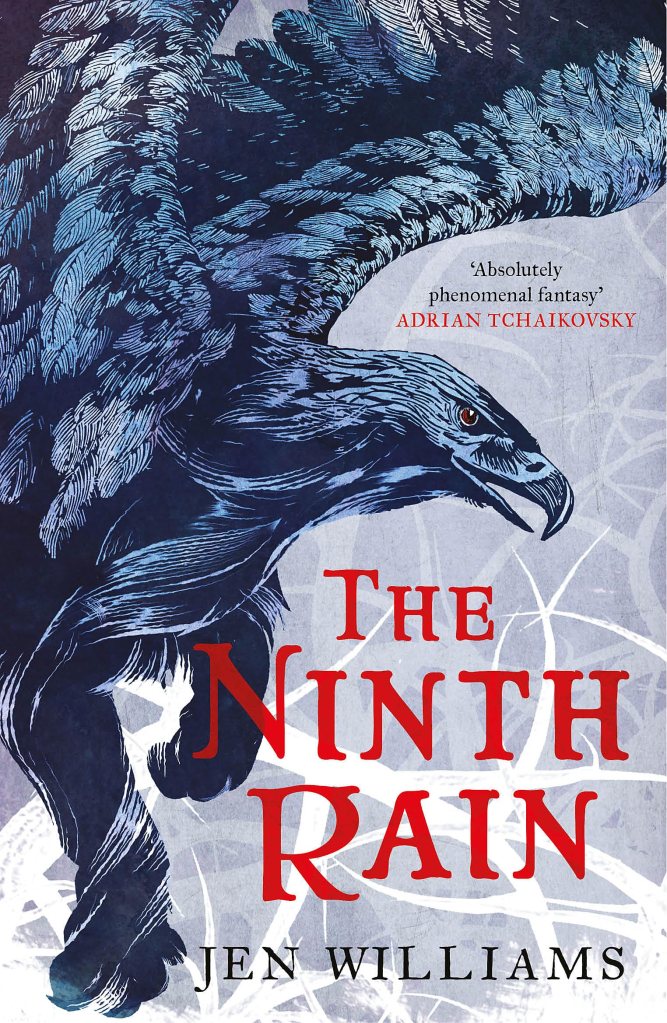
The Ninth Rain, a fantasy novel written by British author Jen Williams, introduces the reader to an intricate and colorful world, Sarn, which has suffered several brutal attacks by an alien army, the Jure’lia. The last war resulted in the death of a god and the subsequent decay of its legendary people, the Eborans. The novel follows an unlikely trio – a human in search of answers, an Eboran outrunning a cruel fate, and a fire-wielding witch fleeing her past – on a journey across Sarn as the threat of another Jure’lia invasion looms on the horizon. The layered world building, suspenseful plot, and dynamic characters made reading The Ninth Rain an exciting adventure, and I’m looking forward to picking up the next book in the trilogy.
“There is, it seems to me, a certain type of man who is terrified of the idea of a woman wielding power of any sort; the type of man who is willing to dress up his terror in any sort of trappings to legitimise it.”
Williams expertly crafts Sarn without overwhelming the reader with details, an especially impressive feat because the plot is packed with complex politics and history. Aware of the intricate world she had created, she provides helpful explanations and context through journal entries written by one of the central characters, Vintage. At points they distracted me and slightly disrupted the flow of the plot, but overall, I was grateful for the extra insights. One element I sorely missed, though, was a map at the beginning of the book.
Williams is a master at showing emotions and revealing character traits through actions. Additionally, suspense was skillfully built up throughout the novel, and action sequences were written well enough to play like movie scenes in my head. The nuanced world building and dynamic action make The Ninth Rain a compelling and memorable book.
“It helps to understand things, don’t you think? It makes them less alarming.”
It’s quickly established that Sarn’s inhabitants have survived eight horrific attacks by the Jure’lia, as well as a bloody war amongst two of its own peoples: Eborans (think Elves from Lord of the Rings) and humans. Complicated history is presented quickly, so you need to be comfortable feeling confused and slowly connecting the dots. You’ll likely have questions for a good portion of the novel, but the journal entries definitely help the reader sift through the complexity. Similar to my wish for a map, I would’ve appreciated additional details on Sarn’s geographical makeup. I often wondered how the land was divided, how the governments operated, and how many territories made up the world.
One of the best aspects of the plot is the strong presence of women, with three female main characters. It’s a stark contrast from the male-dominated plots of other fantasies. I don’t believe the book should be classified wholly as a fantasy, however, as it also contains sci-fi elements like an alien invasion and futuristic technology. The plot builds towards the reveal of a central mystery – what happened at the end of the eighth war with the Jure’lia, and will they invade Sarn once again? The reader discovers the truth alongside the characters. The story also has a romantic sub-plot and magical elements, which are slowly developed throughout the novel. Overall, the joy of The Ninth Rain lies in uncovering secrets piece by piece, alongside diverse and compelling characters.
“Any institution that claims to keep women locked up for their own good should be watched very close, in my opinion.”
The characters are my favorite part of The Ninth Rain. Hestillion, an Eboran, is dangerously loyal to her people’s god, Ygseril, who mysteriously died at the end of the last war with the Jure’lia. She will undertake unspeakable tasks to try to revive him. Her brother, Tor, has the cocky manner unsurprising of a graceful people like the Eborans, but he cares deeply for his human friends. Vintage, a middle-aged human from a wealthy family, is the female equivalent of Indiana Jones – her life has been dedicated to studying the remnants of the Jure’lia. She’s inquisitive, independent, and brave, but also too willing to lead others into dangerous situations in the name of scientific discoveries. The final main character, Noon, is a young fell-witch, meaning she can produce lethal fire by absorbing the life energy from living things, and as a result, she has been imprisoned for ten years. She’s tough, resilient, and quick-witted, which leads to her escape from her captor – a powerful institution called the Winnowry.
Tor and Vintage have formed an unlikely partnership at the start of The Ninth Rain, and I thoroughly enjoyed their humorous dynamic. Despite his arrogance, Tor is gifted with a sword and stronger than Vintage, while Vintage is the personable mediator of the duo – she’s likable where he’s not, and is skilled at de-escalating tense situations. Noon soon becomes a third member of the group, and it was interesting to witness the intersection of their complicated histories and unique personalities. It was especially enjoyable to watch Noon’s character development, as she confronts her past and allows her personality to peek through – she’s candid and blunt, with zero hesitation when asking uncomfortable questions. The three characters begin to form found-family bonds.
Williams assigns each character a distinctive speaking voice, so I was never confused by the rotating points of view. Even side characters contained depth in their backgrounds and personalities, setting them up for bigger roles in the next two books. The richly crafted characters further enhance the novel’s writing and plot.
“Don’t be afraid of who you are.”
As with any book, I may miss the mark entirely on the author’s intended message, but with The Ninth Rain, I felt Williams emphasizing the equalizing force of war. External threats unite people usually at odds – Tor is a good example because he forms relationships with humans that benefit him while also providing something in return, despite the bloody history between their peoples. Additionally, Noon sets aside her fear of Eborans to work alongside him.
Williams also touches on society’s fear of powerful women and people who are different, as evidenced by the creation of the Winnowry. It was established by a man to permanently imprison fell-witches, who are exclusively women. The Winnowry harnesses the fell-witches’ fire, called winnowfire, to produce a drug that garners enormous wealth and influence for the institution, while the fell-witches receive zero benefits. Instead of helping the women control their power, the Winnowry spreads fear of their abilities throughout society so they can never live a peaceful and free life. Noon proves that powerful women can aid society with the very abilities that make them pariahs.
Vintage and Noon represent two additional themes. Vintage highlights the power of knowledge, proving that understanding the past can better prepare you for the future. With Noon, Williams explores the importance of acknowledging the past without abandoning hope of a better future. As a whole, all of the themes weave a narrative which challenges societal norms, confronts challenging histories to pave a brighter future, and celebrates the understanding and strength found within unlikely alliances.
“Show me a people who don’t have a bloody history.”
If you crack open the pages of The Ninth Rain, you can expect layered world building, nuanced themes, strong character work, and a suspenseful mystery. It was exciting to discover its secrets alongside the rich characters, and I’m looking forward to diving into the second book.
You might like The Ninth Rain if you enjoy:
- Fantasy novels with sci-fi twists
- Slowly-revealed mysteries
- Strong female characters
- Found-family elements
- Rich fantasy worlds without gratuitous violence
Buy a copy of The Ninth Rain at the following links:
Check out the synopsis and reviews on Goodreads
Follow the author, Jen Williams, on Instagram
 Hobbies & Happiness
Leave a comment