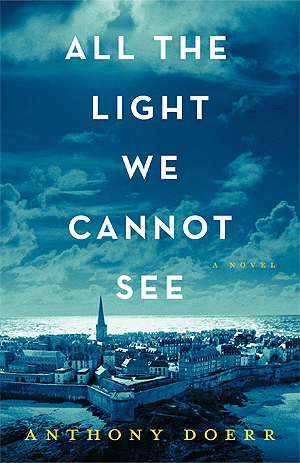
“Beautiful” and “quietly devastating” are the descriptions I’d use when talking about Anthony Doerr’s historical fiction All the Light We Cannot See. The lives of a blind French girl, Marie-Laure Leblanc, and an orphan German boy, Werner Pfennig, intertwine in subtle yet impactful ways as they navigate the treachery of World War II. They suffer tremendous loss as the landscapes of their lives are forever altered, but they continue to encounter people who shine dazzling lights in the darkness by providing hope and love in the bleakest moments. All the Light We Cannot See is not a quick read, and it certainly isn’t fluffy – it will test your dedication before it reveals the heartbreaking result of its intricate writing and carefully crafted plot. By the end of the novel, you will feel as if you grew up alongside Marie-Laure and Werner, and your heart will ache for them long after you’ve placed the book back on your shelf.
“Walk the paths of logic. Every outcome has its cause, and every predicament has its solution. Every lock its key.”
All the Light We Cannot See features highly sensory writing. Doerr wields sound, smell, taste, and touch as replacements for Marie-Laure’s sight. The prose is lyrical and elaborate – I’m certain I could read the book multiple times and still uncover new meanings. It occasionally felt dense and tedious, but I was regularly impressed by Doerr’s talent for transforming ordinary sentences into emotional phrases. Another interesting aspect of the writing: Doerr switches points-of-view to any character as needed, even if it’s only once – a tactic which allows for deeper exploration of the plot. With richly sensory and lyrical prose, vivid details, and flexible POV shifts, he has created an emotionally-layered narrative that rewards slow, attentive readers.
“Music spirals out of the radios, and it is splendid to drowse on the davenport, to be warm and fed, to feel the sentences hoist her up and carry her somewhere else.”
All the Light We Cannot See has an unhurried plot. The novel is ultimately a character study. Readers follow Marie-Laure and Werner from childhood to adulthood as experiences shape their lives and they learn to survive the realities of a world war. You will feel stronger emotions when misfortune strikes because immense care has been taken to intimately familiarize the readers with the characters. Although Marie-Laure is in France and Werner in Germany, their storylines subtly mirror each other in stakes, danger, and anticipation.
The plot had the greatest lull around the 240-page mark, but the entire book is slowly building towards greater danger. It begins with the looming threat of war before transitioning to dangers during wartime, with a steady increase as the German forces realize they’re losing and desperation seeps into their ranks. I recommend brushing up on the Nazi’s major movements prior to reading the novel, simply for useful context.
The book switches back and forth between two main time periods: the occupation of Saint-Malo, France by the Nazis and the days after its liberation by Allied forces. Readers will also experience Paris before it’s invaded and Berlin during the war. It was fascinating to compare the glamor of the Nazi’s wealthy and high-ranking members with the bleak, hard lives of the poor, the persecuted, and anyone who didn’t fit the Nazi mold. Overall, All the Light We Cannot See unfolds as a slow, immersive character study tracing Marie-Laure’s and Werner’s parallel journeys through World War II, weaving together multiple timelines to highlight the emotional stakes under Nazi rule.
“And know that I am always with you, that I am right beside you.”
Each central character was assigned an interesting or defining quirk. Marie-Laure is curious, intelligent, and imaginative, but her blindness makes her an easy target for the Germans. She must rely heavily on aid from sighted people to ensure her safety. My favorite of her characteristics is her propensity for befriending outcasts. Being different herself, she understands them on a deeper level. Like Marie-Laure, Werner is curious and intelligent, as well as inventive, protective, and kind – he’s overall very moral, but he struggles with intense guilt as he aids the Nazi cause.
Werner’s sister, Jutta, wears her heart on her sleeve. She shares characteristics with another character, Madame Manec, who refuses to compromise her morals despite the threat to her life. Werner’s friend, Frederick (perhaps my favorite character), is gentle, kind, inquisitive, and adores living creatures. He’s also brave in a way which inspires Werner (and me). The final character I’d like to describe is Uncle Etienne, a kind yet traumatized man who has been floating through life like a ghost when Marie-Laure enters his world. As you may have gathered, every main character stands out in stark contrast with the environment of World War II. They are all the antithesis of the violent, hateful Nazis, which only heightens the stakes.
“…Isn’t life a kind of corruption? A child is born, and the world sets in upon it. Taking things from it, stuffing things into it. Each bite of food, each particle of light entering the eye – the body can never be pure.”
The book’s title is proof of the most prevalent theme – beauty and wonder can be found in both the seen and unseen, in every thing and everywhere, with all of the senses. Despite being blind and living a nightmare, Marie-Laure notices love, hope, and beauty in many circumstances, from the Jules Verne novels she voraciously consumes to the snails clinging to the hidden crevices in Saint-Malo, but especially in the people who make up her small world. All the Light We Cannot See underscores the importance of finding the light in darkness, and how it is often created by other brave humans.
Another theme I greatly appreciated in the novel is that inaction is still action, because everyone is always making a choice. Werner believes that he lost control of his life the moment he became an orphan, or perhaps from the second he was born into a community where the only employment is laboring night and day in the depths of coal mines. Only when he meets Frederick, who gently but bravely refuses to comply with Nazi expectations of teenage masculinity, does he realize he may have had a choice in his destiny all along – a kernel of truth he fully embraces towards the end of the book. All the Light We Cannot See ultimately argues that beauty, hope, and human-made light endure even in darkness, while also revealing that every choice – even inaction – shapes one’s destiny.
“‘Don’t you ever get tired of believing…? Don’t you ever want proof?’ ‘You must never stop believing. That’s the most important thing.”‘
All the Light We Cannot See will stick with you even after you’ve moved on to your next book. It sets a methodical plot pace with its character-driven focus and descriptive writing, creating an emotional punch of an ending. The characters are beacons of hope and love despite their dark and dangerous circumstances. Marie-Laure and Werner learn to survive the horrors of World War II as their lives connect in ingenious ways, resulting in a beautiful and quietly devastating literary masterpiece.
You might like All the Light We Cannot See if you enjoy:
- Historical fiction
- Character-driven stories
- Lyrical, descriptive prose
- Books with multiple perspectives
- Themes of resilience and hope
Buy a copy of All the Light We Cannot See at the following links:
Check out the synopsis and reviews on Goodreads
Follow the author, Anthony Doerr, on Instagram
 Hobbies & Happiness
Leave a comment