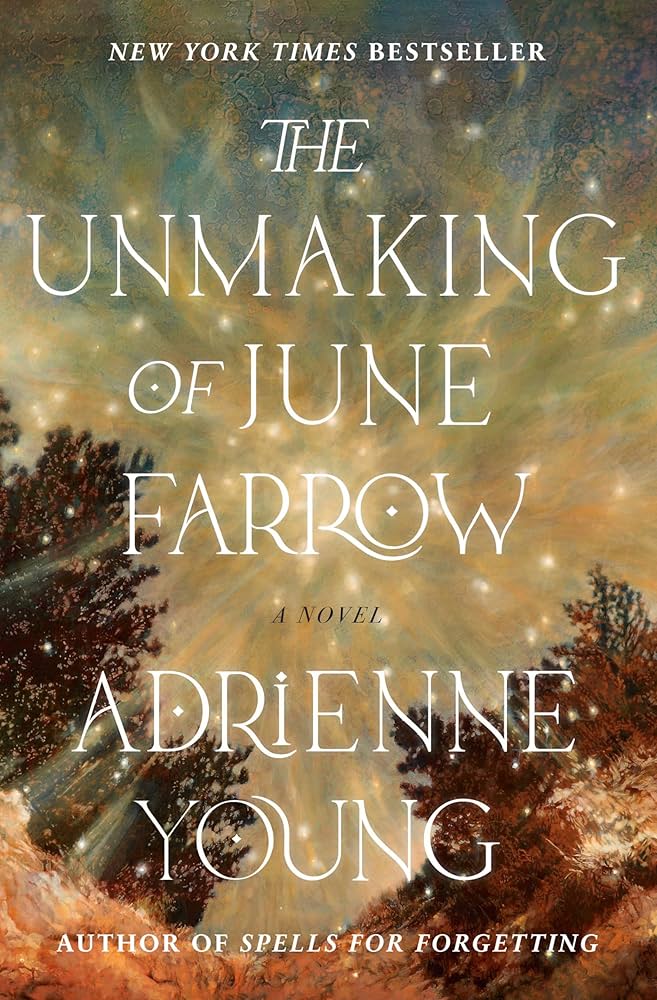
Adrienne Young’s The Unmaking of June Farrow is marketed as magical realism, and it certainly includes magical elements, but I believe it’s better marketed as a romance. It follows the title character, June – a woman in her 30s struggling with a generational curse. All of her female ancestors have succumbed to an unexplainable madness, a fact which compels her to live a life of isolation. She’s determined that the illness will end with her…until she walks through an ominous red door and makes a life-altering discovery. The plot relies heavily on miscommunication and the characters aren’t the most memorable, but I appreciated the underlying feminist themes, lush writing, and tender romance.
“I suspect that the ache of missing her would mostly come from those little things. The holes that were left behind, empty places I’d stumble upon now that she was gone.”
If atmospheric writing is your literary preference, then I recommend The Unmaking of June Farrow. Young transports the reader to quiet Jasper, North Carolina – a small town nestled in the Blue Ridge Mountains. A sense of rural living is cemented in the southern twang of the character dialogue. You hear the rush of the nearby river and whispering of tobacco leaves in the wind. You smell freshly-brewed coffee in the morning. You see the soft, blue-hued peaks of the mountain range enveloping the close-knit community.
Although the author built detailed settings, she didn’t properly establish the book’s time period. I’ll refrain from specifics to avoid spoilers, but Young didn’t utilize any materials – hairstyles, fashion choices, national events, etc. – to convince the reader of the novel’s chosen decade. Honing in on the time period would’ve further enhanced the immersive writing.
Mystery is a substantial element of the story, and the withholding of information is frequently emphasized – that is, Young often uses phrases such as, “She wasn’t saying as much as she could,” “I know he wasn’t telling me everything,” or “I must know the truth.” The frequent repetition of June’s – and the reader’s – lack of knowledge may lead to frustration.
The author elevates The Unmaking of June Farrow with cinematic writing, although she missed an opportunity to amplify it with details from the book’s time period. Despite the redundant language regarding the mystery, the novel may be a hit with readers searching for vivid settings.
“It was one thing to miss her when she was gone. It was another to miss her when she was still here, in this house with me.”
An intriguing, unsettling tone is immediately established in The Unmaking of June Farrow, with ghostly apparitions and unexplainable madness. The reader is introduced to June as she’s grappling with clues related to her missing mother and a murder cold case. Mysteries reside within mysteries, creating a great amount of suspense. I was expecting an explosive ending due to the buildup, so I was surprised by the softness of the resolution. Importantly, even when truths were finally revealed, I had many unanswered questions.
Miscommunication is a key plot device. For the majority of the novel, the characters choose to omit significant information when speaking with June. Once the mysteries were solved in the last quarter of the book, I realized that miscommunication had been the only obstacle to quicker resolutions. In other words, it was a crutch used to prolong suspense.
The book’s synopsis mentions that it’s a “novel of romance,” and Young delivers on that expectation. You could assign The Unmaking of June Farrow to the genres of historical fiction or magical realism, but I believe it most strongly belongs in the romance category. The story is brimming with slow-burn yearning and heartwarming romantic tenderness. It takes precedence over the more ominous, mysterious aspects of the plot, which may be the reason I finished the book with more questions than answers.
I was gripped by the sinister tones in The Unmaking of June Farrow, but I was disappointed by Young’s dependence on miscommunication to propel the plot. Although the romance was prioritized over resolving all of the mysteries, it was written beautifully and filled with longing, desire, and deep affection.
“My world was a very small one, made up of only a few people and places, and it felt like it was shrinking by the second.”
June’s female family members are significant to the novel’s plot and themes, but they blended together in my mind. Puzzlingly, although frequently present in the book, I can’t recall their individual personalities or defining features. The same is true for June’s love interest. He’s portrayed as a handsome, stoic man, whose overprotective nature is his singular flaw. I found the story’s antagonists to be the most fascinating characters, but they had a limited presence. The characters are likable because the reader is shown their best qualities, a situation that many readers may not mind but which left me wishing for more depth.
“I’d sink down and let the roar drown everything else out as I watched the light ripple above me in bursts that looked like stars exploding. And when my lungs couldn’t stand it any longer, when it felt like there was a storm in my chest, I’d shoot up to the surface, gasping for air. That’s what this felt like.”
I appreciated the themes woven into the novel, one of which is the common overshadowing of a woman’s contributions by those of her husband’s achievements. The life of June’s mother is forgotten by Jasper’s townspeople, while her husband’s legacy lives on with admiration and respect. Another theme underlying the entire book is the willingness to label a woman “mad” to explain unusual behavior (by societal standards), rather than investigating the true causes of such behavior. June’s female family members are plagued by a phenomenon that every townsperson, and even the Farrows themselves, call “madness” – but is it truly? The reader will spend the whole novel exploring this question.
I’d also like to mention a thematic element that I found impressive – Young twists the female madness problem on its head. At least one of the characters is truly mad, but it’s not any of the Farrow women. Overall, the author successfully highlighted the misogynistic tendency to glorify men’s achievements and ignore women’s, as well as the ease with which people assign “madness” to a woman’s behavior.
“Was I becoming someone else, or was I just finally becoming myself?”
The Unmaking of June Farrow explores the minimization of women and the ease with which people call them crazy – isolating them on the fringes of society. I craved more character development but appreciated the slow-burn, emotional romance. Miscommunication was an overused plot device and I was unsatisfied by the answers, or lack thereof, to the central mysteries, but I had a wonderful experience with the immersive writing style.
You might enjoy The Unmaking of June Farrow if you like:
- Atmospheric, small-town settings
- Gradually unraveling secrets
- Time-bending narratives
- Novels emphasizing internal conflicts and emotional stakes
- Romantic tension embedded within a larger mystery
Buy a copy of The Unmaking of June Farrow at the following links:
Check out the synopsis and reviews on Goodreads
Follow the author, Adrienne Young, on Instagram
 Hobbies & Happiness
Leave a comment