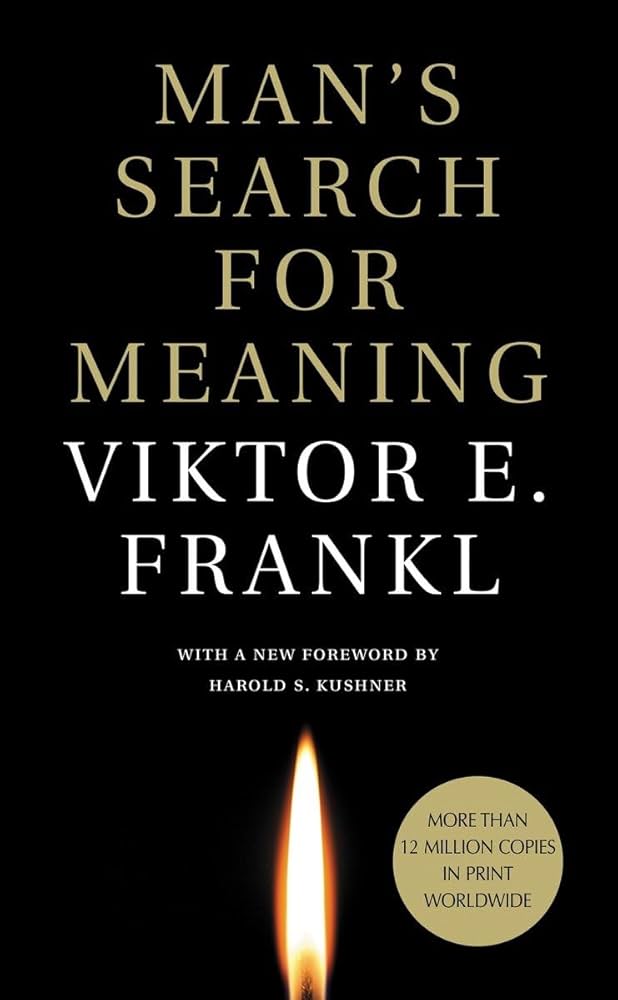
Have you heard the name Viktor E. Frankl? He’s a source of inspiration for countless people because of his memoir, Man’s Search for Meaning. Within a mere 196 pages, the renowned psychiatrist recounts his three years imprisoned in Nazi concentration camps and provides an introduction to logotherapy – his psychological theory now studied on a global scale. Man’s Search for Meaning will offer invaluable perspective to whomever reads it, as it explores the importance of finding one’s purpose in life and discovering the true meaning behind suffering.
“Everything can be taken from a man but one thing: the last of the human freedoms—to choose one’s attitude in any given set of circumstances, to choose one’s own way.”
Man’s Search for Meaning could have easily been written with dramatic prose to keep the reader in tears. Instead, Frankl recalls his experiences in Auschwitz, Dachau, and other concentration camps with a matter-of-fact tone. The writing in the first part of the book is similar to an academic paper, while the second half is reminiscent of a textbook. In my opinion, the writing style perfectly matches the author and the intent of the memoir. Frankl was a psychiatrist prior to his internment, so it is only natural that he chose to relay events with a psychiatric focus. The reader will receive plenty of specific descriptions of the atrocities within the camps, but he or she will also gain an understanding of the prisoners’ mental states. Both Frankl’s livelihood and the topic of his memoir are scientific, with a focus on teaching others; therefore, the writing adopts an academic style.
“When we are no longer able to change a situation, we are challenged to change ourselves.”
The book was split into two sections: a psychiatric-focused recounting of Frankl’s three years in concentration camps, and a beginner’s explanation of logotherapy with real-world examples and applications. I’m not exaggerating in the slightest when I claim that the first half completely changed my outlook on the difficulties I face in my own life. I have never experienced suffering of the same magnitude as Frankl; I have never been starved to the brink of death, made to work until my body begins to physically break, or forced to helplessly watch as my friends and family are rounded up and slaughtered like animals. Frankl has helped me regain gratitude for my life. I more easily see the beauty in things I had previously overlooked or dismissed. I remember to cherish my loved ones more often, because everything could drastically change in the span of one day.
It took me longer to read the second half of the book because of its academic writing style, but it maintains the same level of importance as the first. The reader has been given an excellent historical example of the importance of finding meaning in suffering, and now he or she will learn how to apply the principles of logotherapy in modern situations. Frankl gives helpful definitions and uses his patients’ experiences as examples. You will definitely learn how to discover meaning in your own life. I particularly appreciated Frankl’s emphasis on the importance of love and his discussion on finding purpose in your later years. Although not written like a dramatic fiction, you’ll still become heavily invested in and inspired by Man’s Search for Meaning.
“Those who have a ‘why’ to live, can bear with almost any ‘how’.”
Through the matter-of-fact writing and scientific approach in Man’s Search for Meaning, Frankl successfully explains the value in finding positivity, hope, and meaning in the dark depths of suffering, but also in the ordinary moments. I believe each person in the world can benefit from reading it.
You might like Man’s Search for Meaning if you enjoy:
- Memoirs
- Self-help
- Books exploring meaning and purpose in life
- WWII and/or Nazi concentration camp stories/history
- Psychology
Buy a copy of Man’s Search for Meaning at the following links:
Check out the synopsis and reviews on Goodreads

 Hobbies & Happiness
Leave a comment